Most LinkedIn profiles look alike. A job title in the headline, a vague two-line summary, a list of past employers, and nothing that tells a recruiter why they should reach out instead of moving on to the next profile.
If you’re actively job seeking, your LinkedIn profile isn’t just a digital resume. It’s one of the main places where recruiters can find you before you ever apply. That matters because many opportunities are in the hidden job market, where employers source, refer, or contact candidates before a job post is published. If you are not sure which recruiters to connect with first, our guide on how to find a recruiter explains where to look and how to approach them professionally. LinkedIn also notes that a complete profile can improve your discoverability and profile search appearances, making profile optimization more than a cosmetic exercise.
What follows are practical LinkedIn profile examples for job seekers, broken down section by section: headline formulas, About section samples across eight roles, banner ideas, and a full sample profile. Read it end to end or jump to the section you need.
Why your LinkedIn profile matters more than your resume
Recruiters don’t wait for applications. When a role opens up, many search LinkedIn, review referrals, and build shortlists before a job post reaches the wider market. That is why your profile needs to function as a searchable career page, not just a copy of your resume.
The details matter. LinkedIn says a complete profile can increase discoverability and profile search appearances. LinkedIn has also reported that members who include a profile photo receive 21x more profile views and up to 36x more messages, which reinforces a simple point: a complete, credible, and visually professional profile gives recruiters more reasons to stop and read. Source.
Most job seekers still treat LinkedIn like an afterthought, a place to paste the resume and move on. The profiles that actually attract recruiters are keyword-rich, specific, and written for the reader, not for the writer.
The LinkedIn profile template: every section that gets you found
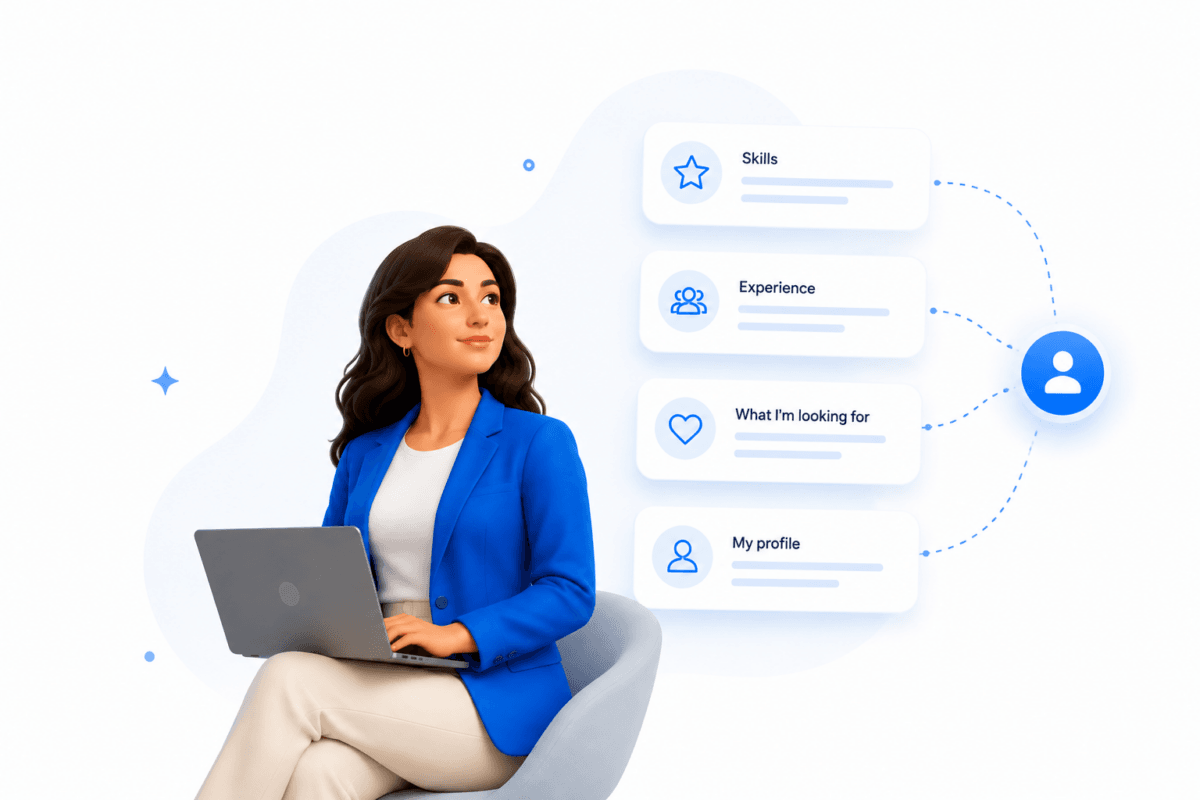
Each section of your LinkedIn profile does a different job. Here’s what matters in each one.
Profile photo
Your photo is the first thing anyone sees. It doesn’t need to be a professional headshot, but it should be clear, front-facing, and reasonably recent. A plain or softly blurred background works well. Avoid group photos, sunglasses, or anything cropped from a social event.
Background banner
Your LinkedIn background banner appears behind your profile photo and extends across the top of your profile. Many job seekers leave it blank, but a custom LinkedIn background photo, cover image, or header image can quickly reinforce your professional identity.
Keep it simple. Use your LinkedIn banner to show your field, your portfolio, your industry, or a short value statement. For example, a software engineer might use a clean code or product interface visual, a designer might feature a portfolio snapshot, and a project manager might use a simple operations or team collaboration theme. Avoid cluttered graphics, tiny text, or anything that distracts from your headline and profile photo.
Headline
Your headline appears directly under your name, in search results, and in every recruiter’s inbox where your name comes up. It defaults to your current job title, which is the most common mistake job seekers make. A headline that says “Marketing Manager” tells a recruiter your title. A headline that says “Marketing Manager specializing in B2B SaaS growth, open to new opportunities” tells them your specialty, signals availability, and gives them a reason to click.
About section
The About section (formerly called the Summary) is where you have the most room to tell your story. LinkedIn allows up to 2,600 characters here, though 300 to 500 words is typically the right length. This section should explain what you do, what you’re good at, and what kind of role you’re looking for, written in first person and addressed to a recruiter who’s scanning it in under 30 seconds.
Experience
Each role in your Experience section should go beyond a job description. Use bullet points or short paragraphs to show what you accomplished in each position, with numbers wherever possible. “Managed a team” tells a recruiter nothing. “Managed a team of six, cutting project turnaround time by 30% over two quarters” gives them something concrete. If you need guidance on what to include here, the guide on things to put on a resume covers every section in detail, and much of it applies directly to your LinkedIn Experience entries, too.
Skills
LinkedIn lets you list up to 50 skills. Use the ones that are genuinely relevant to the roles you’re targeting and match the language used in job postings. A good starting point is to compare your target roles with the in-demand skills employers are hiring for now, then prioritize the skills you can honestly support with experience, projects, or certifications. Endorsements from colleagues add credibility, and the keywords in your skills section also influence how often you appear in recruiter searches.
Featured section
The Featured section sits near the top of your profile and lets you pin content: articles you’ve written, links to portfolio work, presentations, or media coverage. For job seekers, this is a strong place to demonstrate expertise before a recruiter even scrolls down.
Recommendations
Ask two or three former managers, clients, or colleagues for short recommendations that mention specific strengths, projects, or results. A strong recommendation validates what your headline, About section, and Experience entries already claim.
Education and certifications
Keep your education current and accurate. Add relevant certifications, especially recent ones that signal upskilling in your target field. If you’ve completed a certification in the past 12 months that’s relevant to the roles you want, it’s worth mentioning in your About section too.
LinkedIn headline examples for job seekers (with formulas)
Your headline is the most-read line on your entire profile. Three formulas that work consistently, followed by examples across different roles.
Formula 1: [Role] | [Specialty or skill] | [Signal of availability or goal] Formula 2: [Role] helping [target audience] [achieve outcome] | Open to [type of role] Formula 3: [Years of experience] [Role] | [Industry or tool] | [Differentiator]
Headline examples by role
Software Engineer “Full-Stack Engineer | React, Node.js, AWS | Building scalable products for early-stage startups | Open to senior engineering roles”.
Project Manager “PMP-Certified Project Manager | SaaS and FinTech | Delivered 40+ cross-functional projects on time and under budget”.
Marketing Manager “B2B Marketing Manager | Demand Gen and Content | Helped SaaS companies grow pipeline by 3x | Open to new opportunities”.
Sales Executive “Enterprise Sales | $2M+ in closed revenue annually | Building long-term client relationships in tech and professional services”.
HR Professional “HR Business Partner | Talent Acquisition, Employee Experience | Helped scale teams from 50 to 300+ at Series B startups”.
Financial Analyst “Financial Analyst | FP&A and Financial Modeling | Excel, SQL, Tableau | Open to roles in corporate finance and investment”
Graphic Designer “Brand and Visual Designer | Helping product teams translate strategy into design systems | Figma, Adobe CC”.
Career Changer (into UX Design) “Former Marketing Manager transitioning into UX | Google UX Design Certificate | Portfolio: [link] | Open to junior UX roles”.
Every one of these works because it’s specific. A recruiter scanning search results can tell within three seconds what this person does, what makes them useful, and whether to click through.
A well-built LinkedIn profile is only part of the equation. Talentprise’s AI job discovery platform takes your skills and experience and matches you with employers actively looking for candidates like you, without the keyword guessing that comes with traditional job boards. Free to join for job seekers.
LinkedIn About section examples by role
The About section is where many job seekers either write nothing useful or paste in a version of their resume. LinkedIn still surfaces it in searches under both “About section” and “summary,” so if you’re looking for LinkedIn summary examples or LinkedIn about section examples, these are one and the same thing. The examples below show what it looks like when the About section actually works, written in first person, focused on value, and built around the keywords recruiters search for.
Each example runs between 200 and 400 words, enough to cover the essentials without losing the reader. Use them as a LinkedIn about section template you can adapt to your own background: keep the structure, swap in your own experience and numbers, and write in your own voice.
If you’re looking for LinkedIn About section ideas beyond what’s here, the core formula stays the same regardless of role: open with what you do and how long you’ve been doing it, show one or two specific results, explain what you’re looking for, and close with an invitation to connect. Think of it as a career summary in paragraph form, not a list of past jobs.
Software Engineer
I’m a full-stack engineer with six years of experience building web applications for early-stage and growth-stage startups. My work spans the full product lifecycle, from initial architecture decisions to shipping features used by tens of thousands of users.
I specialize in JavaScript and TypeScript on both the front end (React, Next.js) and back end (Node.js, Express), with solid experience with AWS cloud infrastructure. I care about writing code that’s clean, testable, and easy for the next person to maintain.
In my most recent role, I led the engineering team in migrating to a microservices architecture, reducing deployment time by 40% and significantly improving system uptime. I’ve worked closely with product managers and designers throughout my career and genuinely enjoy the collaboration that comes with small, focused teams.
I’m currently looking for a senior engineering role at a company where technical quality matters, and there’s room to grow into technical leadership over time. Open to remote, hybrid, or Toronto-based positions.
Feel free to reach out, I’m happy to connect.
Project Manager
I’m a PMP-certified project manager with eight years of experience delivering complex software and operational projects for technology companies. I’ve managed cross-functional teams of up to 20 people and overseen projects with budgets ranging from $500K to $4M.
My approach combines structured planning with practical flexibility. I use Agile and Scrum methodologies where they make sense, and I’m equally comfortable managing Waterfall delivery for enterprise projects with strict compliance requirements. Tools I work with daily include Jira, Confluence, MS Project, and Notion.
Over the past three years, I’ve specialized in SaaS product launches, coordinating engineering, product, marketing, and customer success to bring new features from concept to market. One highlight: I led a platform migration for a fintech client that affected 200,000 end users with zero downtime.
I’m currently exploring new roles where I can take on broader program management responsibilities and work with teams building meaningful products. Based in Austin, Texas; open to remote positions.
Marketing Manager
I’m a B2B marketing manager with seven years of experience in demand generation, content strategy, and marketing operations. I’ve spent most of my career at SaaS companies, working alongside sales teams to build pipelines and turn content into a reliable source of qualified leads.
My work spans campaign management, SEO, email nurture, and event marketing. I’m comfortable owning a strategy and rolling up my sleeves to execute. I’ve managed solo and been part of teams of up to 12, so I adapt easily to different environments.
In my last role, I led a demand gen program that grew organic traffic by 180% in 18 months and contributed $1.4M to the pipeline. I work with HubSpot, Salesforce, SEMrush, and Webflow regularly.
I’m looking for a senior- or director-level marketing role at a B2B SaaS company with a real appetite to invest in content and inbound. If that sounds like your team, I’d love to connect.
Sales Executive
I’m a sales professional with 9 years of experience in B2B enterprise sales, specializing in technology and professional services. I’ve consistently exceeded quota, averaging 118% of target over the past four years, and I’ve closed deals ranging from $50K to $2.5M in annual contract value.
My approach is consultative. I spend time understanding a prospect’s actual business problem before positioning any solution, which is why my retention rates are strong and why clients tend to expand their contracts over time.
I’ve sold into financial services, healthcare, and logistics, and I’m comfortable managing long, complex sales cycles with multiple stakeholders. I work in Salesforce and use Gong, Outreach, and LinkedIn Sales Navigator as part of my daily workflow.
Currently looking for an enterprise account executive role at a company with a strong product and a sales culture that values long-term relationships over one-time transactions. Open to connecting.
HR Professional
I’m an HR business partner with ten years of experience supporting high-growth technology companies through rapid headcount scaling, organizational design, and culture development. I’ve partnered with leadership teams at companies scaling from 50 to 500+ employees, helping them build the people infrastructure to support sustainable growth.
My work covers the full employee lifecycle: talent acquisition strategy, onboarding design, performance management, compensation benchmarking, and employee relations. I care particularly about building workplaces where people from underrepresented backgrounds feel they belong and can advance.
In my most recent role, I led the people function during a period of 3x growth, hiring across engineering, product, and go-to-market functions while maintaining an 88% employee satisfaction score. I’m skilled in Workday, BambooHR, Greenhouse, and Lever.
I’m looking for a senior HRBP or Head of People role at a company with a genuine commitment to culture, ideally in tech or professional services. Open to fully remote positions.
Financial Analyst
I’m a financial analyst with five years of experience in FP&A and corporate finance, specializing in financial modeling, budgeting, and long-range planning. I’ve worked in fast-moving environments where the ability to turn raw data into clear financial narratives has made a real difference in how leadership makes decisions.
My technical toolkit includes advanced Excel, SQL, and Tableau. I’m experienced in building three-statement models, rolling forecasts, and scenario analyses from scratch. I’ve also worked closely with business unit leaders to help them understand the financial implications of operational decisions, which means I’m as comfortable in a boardroom presentation as I am in a spreadsheet.
In my last role, I rebuilt the company’s annual budgeting process, reducing the cycle time by three weeks and improving accuracy by 22%.
I’m currently looking for a Senior Financial Analyst or FP&A Manager role, preferably at a technology or consumer company with international operations. Open to hybrid and remote roles.
Graphic Designer
I’m a brand and visual designer with 6 years of experience helping technology companies build scalable design systems. My work sits at the intersection of brand strategy and execution. I enjoy the thinking behind a brand as much as the craft of bringing it to life.
My core tools are Figma, Adobe Illustrator, and Adobe Photoshop. I’ve worked on projects ranging from full brand identity systems to individual campaign assets, product UI design, and fundraising pitch deck design.
Most recently, I led the visual rebrand of a B2B SaaS company ahead of their Series B fundraise, developing a complete design system that the in-house team could use independently after launch. The rebrand contributed to a 35% improvement in website conversion rates.
I’m currently looking for a senior designer role at a company that takes brand seriously and gives designers a seat at the table from the start of projects. My portfolio is linked below, and I’d love to connect.
Career changer (marketing to data analytics)
After seven years in B2B marketing, I’ve made a deliberate move into data analytics, and it’s been the most energizing professional decision I’ve made.
My marketing background gave me a strong foundation for this transition. I’ve spent years working with data: building attribution models, analyzing campaign performance, and helping leadership understand what the numbers actually mean for the business. Moving into analytics felt less like a career change and more like going deeper into the part of my work I found most interesting.
Over the past year, I’ve completed Google’s Data Analytics Certificate and a 12-week intensive program in SQL and Python. I’ve built a portfolio of projects analyzing real datasets from marketing, finance, and operations, all available on GitHub (linked below).
I’m looking for a junior or associate data analyst role where I can apply both my technical skills and my marketing context. Companies where data informs every decision are exactly where I want to be. Happy to connect and share my portfolio.
LinkedIn banner and header ideas for job seekers
Your LinkedIn banner, also called a LinkedIn background photo, cover image, or header image, is not the most important part of your profile, but it can make the page feel more complete and intentional. The best LinkedIn banners for job seekers are simple, role-relevant, and easy to understand at a glance.
- Software engineer: clean product interface, code-inspired graphic, or cloud architecture visual.
- Marketing professional: campaign dashboard, brand moodboard, or simple growth-focused visual.
- Designer: portfolio collage, design system preview, or minimal creative workspace.
- Finance professional: clean data dashboard, financial chart, or corporate cityscape.
- Career changer: simple banner with target role keywords, certification, or portfolio link.
Most job seekers leave their LinkedIn banner blank. That means a blue or grey gradient sits behind their photo and name, telling a visitor nothing about who they are or what they do. A custom banner takes about 20 minutes to create and immediately makes your profile look more intentional than 80% of the people you’re competing against.
What goes on it depends on your field. Engineers and developers often do well with a dark background and a clean code snippet, a system architecture diagram, or a simple callout stating their role and tech stack, alongside “Available for senior engineering roles.” It’s readable in under two seconds and says something specific.
For marketing and design roles, a sample of your actual work tends to say more than any text, whether that’s a campaign visual, a brand identity piece, or a color palette from a project you’re proud of. Keep it minimal; the goal is to show range, not to squeeze in a portfolio.
Finance, operations, and HR professionals generally do better with a clean, text-based banner: name, role, and one or two credentials or specialties. A subtle background pattern keeps it from looking empty without pulling attention away from your profile photo.
Career changers can use the banner to get ahead of the obvious question. Something like “Marketing professional moving into data analytics | Google DA Certified | Open to new roles” tells a recruiter your story before they’ve read a word of your profile.
A few things that apply regardless of the field: keep text to a minimum, use fonts no smaller than 24pt, and make sure the background doesn’t crowd out your photo. Canva, Adobe Express, and LinkedIn’s own banner creator all have free templates in the correct 1584x396px format.
Good LinkedIn profile examples: what a complete profile looks like end-to-end
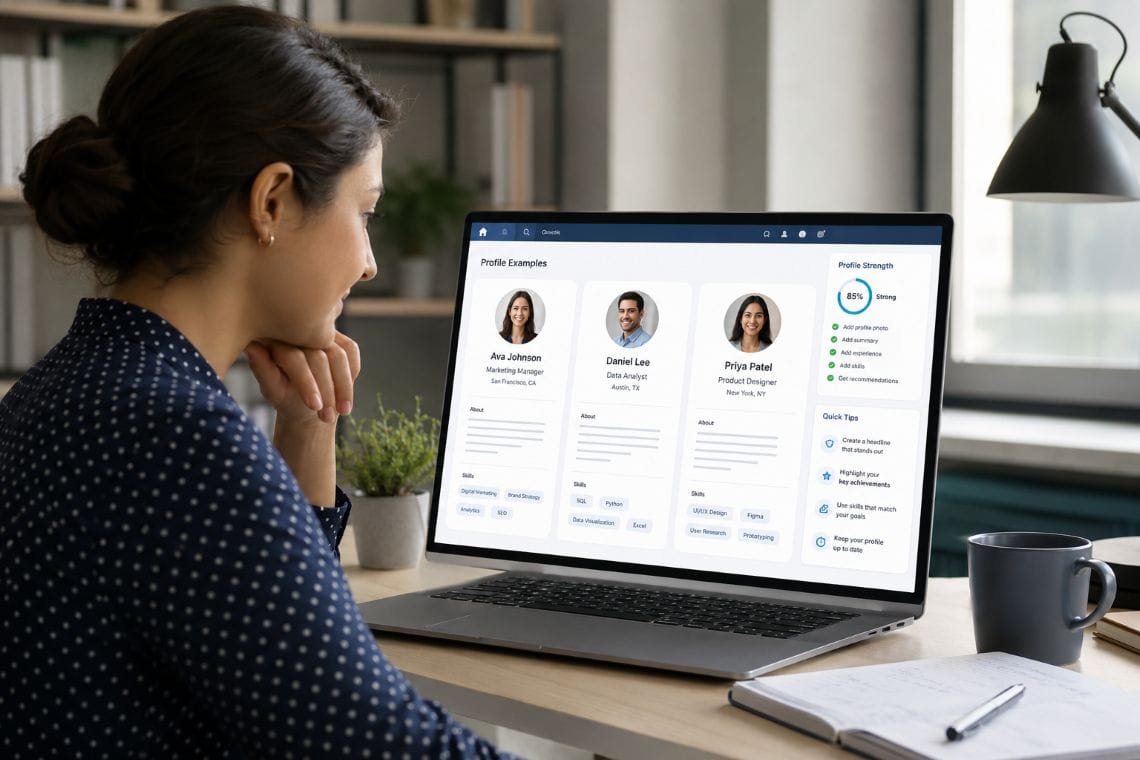
The sections above cover each piece in isolation. Here’s a full sample LinkedIn profile pulled together so you can see what it looks like when everything works at once. This is the kind of good LinkedIn profile example recruiters actually click on: every section completed, every bullet specific, nothing left to default.
If you want a simple LinkedIn About Me template for the About section in this sample, refer back to the Software Engineer example above. The structure transfers to any role.
Name: Alex Rivera Location: Austin, Texas | Open to remote
Headline: Full-Stack Engineer | React, Node.js, AWS | 6 years building scalable products for SaaS startups | Open to senior roles
Banner: Dark navy background with a subtle code pattern. Text overlay: “Full-Stack Engineer | Open to Senior Roles | Remote-Friendly”.
About: I’m a full-stack engineer with six years of experience building web applications for early-stage and growth-stage SaaS companies. [Full About section as written above.]
Experience:
Senior Software Engineer — CloudOps Inc. (2022–Present)
- Led migration of monolithic app to microservices, reducing deployment time by 40%
- Architected a real-time notification system handling 500K+ daily events
- Mentored two junior engineers, running weekly code reviews and pair programming sessions
Software Engineer — BuildIt Labs (2019–2022)
- Built customer-facing dashboard features used by 30,000+ active users
- Improved API response times by 35% through query optimization and caching
- Contributed to open-source React component library (2,000+ GitHub stars)
Skills (top 10): JavaScript, TypeScript, React, Node.js, AWS, PostgreSQL, REST APIs, Git, Agile, System Design
Education: B.Sc. Computer Science — University of Texas at Austin (2019)
Certifications: AWS Certified Solutions Architect — Associate (2024)
Featured:
- GitHub portfolio (pinned).
- Technical blog post: “How We Cut Deployment Time by 40% at CloudOps”.
The headline is specific and searchable. The About section leads with something concrete and is written in the first person. Every Experience bullet shows impact rather than activity. The Featured section gives a recruiter something to explore before they’ve even finished reading. Nothing is vague; nothing is left to default; the whole profile tells a consistent story.
FAQ
Build a profile that gets found
Most people set up their LinkedIn profile once and forget about it. The profiles that bring in recruiter messages are different: a specific headline, a first-person About section that explains the value you bring, experience that shows impact, and a banner that signals you took this seriously.
This guide provides a sample for each major section. Use the examples that fit your role, adapt the ones that are close, and skip what doesn’t apply. If you want to go deeper into career positioning beyond LinkedIn, the guides on career growth strategies and how to find a job in 2026 cover the broader picture. The goal is a profile that works for you when you’re not looking at it.
When you’re ready to get in front of the right employers, Talentprise is a free AI job discovery platform for job seekers where verified recruiters search for candidates using AI matching. You don’t need to send a hundred applications. Build a profile that reflects your actual skills, and relevant employers find you. Create your free Talentprise profile and get discovered by employers who are actively seeking candidates with your background.

Editorial Team
Our team is fueled by a passion for crafting valuable content that enriches the experiences of our users, customers, and visitors. We meticulously select meaningful and unbiased topics ranging from tips and guides to challenges and the latest in technology, trends, and job market insights. All curated with care and affection!