
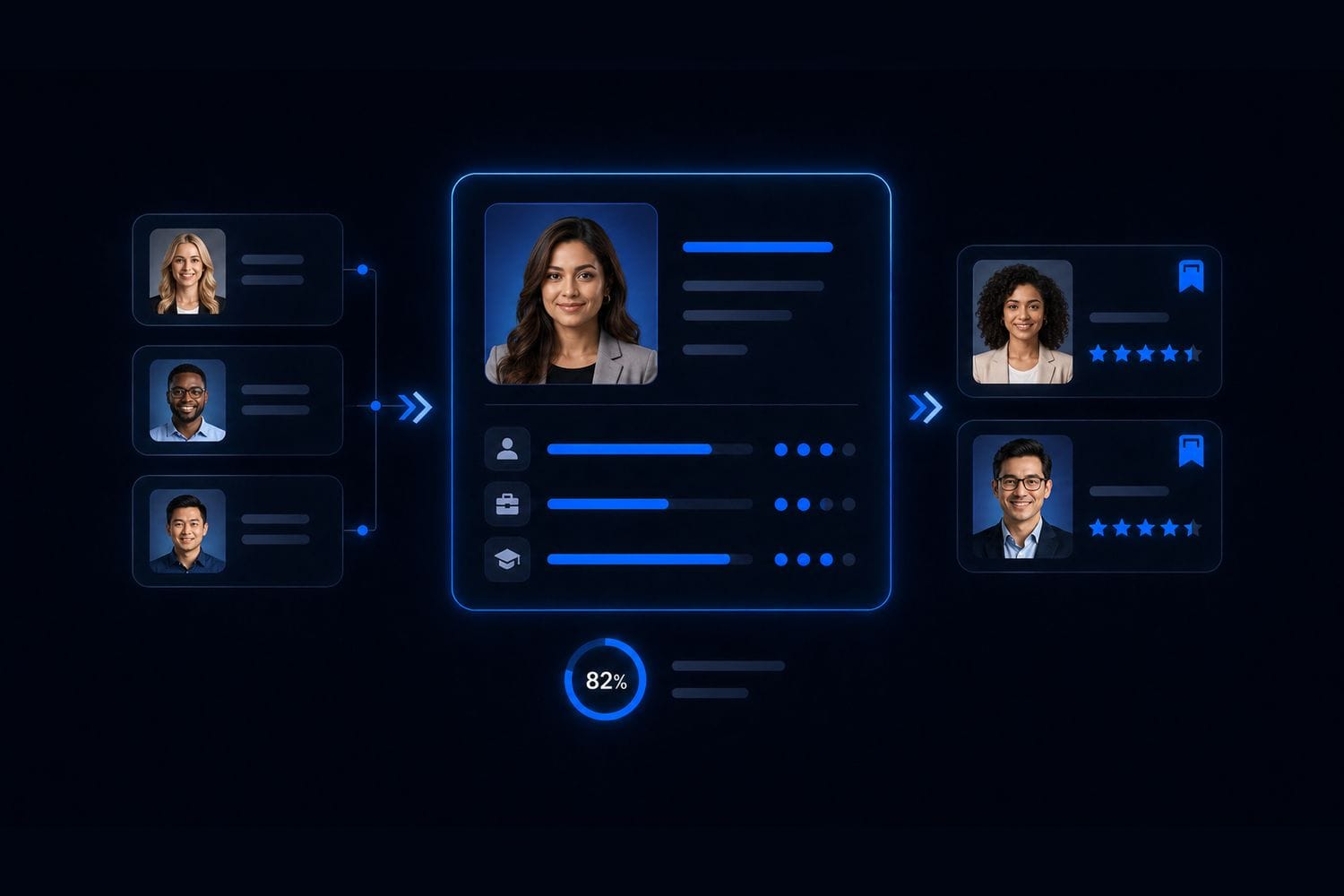
Most hiring mistakes happen earlier than organizations realize. By the time a poor hire starts their first week, the decision is usually made in the screening stage, when criteria are vague, scoring is inconsistent, or the person reviewing CVs relies on instinct rather than evidence.
The quality of candidates reaching that stage is shaped by what happens upstream. A deliberate candidate sourcing strategy determines who enters your funnel in the first place; screening can only work with what sourcing delivers.
A structured candidate screening process doesn’t slow down hiring. Ashby’s 2025 Talent Trends Report, based on over 31 million applications and 95,000 jobs, found that hiring teams are now interviewing approximately 40% more candidates per hire than they were in 2021.
This guide covers how to build one that works, the criteria framework, the scoring methodology, where AI genuinely helps in 2026, and the cognitive biases that undermine screening decisions even when everything else is done right.
Screening vs Shortlisting: The Distinction That Matters
Most guides use these terms interchangeably. They are not at the same stage, and conflating them creates a messy process in which the wrong candidates advance and the right ones get filtered out too early.
Screening is the first pass, eliminating candidates who clearly do not meet the role’s minimum requirements. This is a binary decision: qualified to proceed or not. The criteria are objective and non-negotiable: required qualifications, right-to-work status, minimum years of experience in a specific area, and mandatory certifications. No judgment call. No weighing of trade-offs.
Shortlisting is the comparative stage, ranking the candidates who passed screening against one another to identify the strongest 5–8 for interviews. This requires judgment: evaluating how different candidates’ experiences compare, how their career trajectories signal potential, and how their profiles match the role’s nuanced requirements.
Getting this sequence right matters because the criteria and the evaluator are different at each stage. Screening criteria should be set before any applications arrive. Shortlisting criteria require more contextual judgment and should involve the hiring manager, not just the recruiter.

Step 1: Set Your Shortlisting Criteria Before Any CVs Arrive
The most common screening failure is reviewing applications without predefined criteria—making gut decisions and then rationalizing them afterward. This produces inconsistent outcomes and opens the door to unconscious bias.
Before the role goes live, write down three categories of criteria in order of importance:
Must-haves: qualifications, skills, or experience that are genuinely non-negotiable. If a candidate lacks these, they do not advance regardless of other qualities. Keep this list short: three to five criteria maximum. If your must-have list has eight items, most of them are actually nice-to-haves.
Strong differentiators: qualities that meaningfully elevate a candidate above others at the same minimum qualification level. These don’t eliminate; they rank.
Red flags: patterns from previous hiring experience that have consistently predicted poor fit or poor performance. Write these down explicitly before you start reviewing so you apply consistent judgment rather than post hoc rationalization.
Writing criteria before reviewing applications is not a bureaucratic formality. It is the single most impactful change most hiring teams can make to improve both the speed and quality of shortlisting decisions.
Step 2: Resume Screening. What to Look For and What to Ignore
Resume shortlisting is where most screening time is spent and where bias most frequently enters the process. A structured approach to reading CVs reduces both problems simultaneously. This step comes after the upstream resume database search process.
What to evaluate:
Trajectory, not just titles. A candidate who has progressively taken on more responsibility across three roles is a stronger signal than one who has held a senior title for seven years without visible growth. Look for the direction of travel, not just the current position.
Specificity of evidence. “Managed a team” is not evidence. “Led a team of 8 engineers through a platform migration that reduced infrastructure costs by 30%” is evidence. Vague descriptions of responsibilities signal a candidate who either hasn’t achieved measurable outcomes or hasn’t learned to communicate them; both are useful data points.
Relevant context, not just role names. A software engineer at a 10-person startup operates in a fundamentally different environment from one at a 10,000-person enterprise. Neither is inherently better, but the context changes what the role actually involves and what skills it develops.
What to ignore:
Formatting and design quality: unless design is genuinely part of the role, visual presentation tells you nothing about job-relevant capability. A plain-text CV with strong substance outperforms a beautifully designed CV with vague content every time.
Education institution prestige: for roles where the degree is a minimum requirement, the institution is rarely a meaningful predictor of performance. For technical roles, demonstrated skills in GitHub or portfolio work are more predictive than the name of the university.
Photo and personal details: where not legally required, evaluating candidates with names and photos visible introduces measurable name bias and affinity bias. If your volume allows it, blind screening, evaluating CVs with identifying information removed, consistently increases shortlist diversity without reducing quality. Blind screening is one part of a broader diversity recruiting strategy that also addresses sourcing channels, job description language, structured interviews, and funnel measurement.
Step 3: Build a Candidate Scoring Matrix
A scoring matrix is the most practical tool for consistent candidate shortlisting. It converts subjective impressions into structured, comparable assessments, enabling you to review a longlist of 30 candidates and arrive at a shortlist of 6 with a documented, defensible rationale.
Basic structure:
Criteria | Weight | Candidate A | Candidate B | Candidate C |
|---|---|---|---|---|
Must-have skill 1 | Pass/Fail | |||
Must-have skill 2 | Pass/Fail | — | ||
Differentiator 1 | 1–5 | 4 | 3 | — |
Differentiator 2 | 1–5 | 3 | 5 | — |
Differentiator 3 | 1–5 | 4 | 4 | — |
Weighted total | 11 | 12 | Screened out |
How to weight criteria:
Not all differentiators carry equal weight. A candidate scoring highly on the most important differentiator should rank higher than one with more evenly distributed scores across less critical criteria. Assign numeric weights to each differentiator (e.g., 1–3) and multiply the score by the weight before totaling.
Who fills in the matrix:
For senior or specialist roles, the hiring manager should complete the matrix independently, then compare scores with the recruiter before agreeing on the shortlist. Independent scoring before discussion prevents anchoring, where the first person’s view disproportionately influences everyone else’s assessment.
A consistent scoring matrix applied across all candidates for the same role is also your best protection against a discrimination claim. It creates a documented audit trail of why each candidate was advanced or declined. This data feeds directly into your recruiting metrics, specifically pipeline conversion rate at the screening stage.
Step 4: Phone Screening. The 20-Minute Filter
A structured 15–20-minute phone screen between CV review and the first interview eliminates the most common reason for wasted interviews: candidates who look good on paper but are clearly misaligned in conversation.
The phone screen has three specific purposes, none of which is a full interview:
1. Verify basic facts: confirm that what’s on the CV accurately reflects the candidate’s experience. A surprising number of CVs contain exaggerations that are immediately apparent in a brief conversation. Ask the candidate to walk you through one specific project in their CV. Listen for specificity. Vagueness is a signal.
2. Assess practical availability: salary expectations, notice period, location requirements, and right-to-work confirmation. These are not rude questions. They are essential logistics that determine whether a candidacy is viable before investing further. Discovering them at the offer stage wastes everyone’s time.
3. Test communication and basic role fit: a brief conversation about why the candidate is interested in the role, what they know about the company, and one specific question about a core job requirement. You’re not assessing interview performance. You’re assessing whether there’s a reasonable basis to continue.
Five targeted phone screens tell you more than three hours of CV review. They are the highest-efficiency screening tool available; use them liberally.
For roles where skills assessment is critical before the interview, platforms like Vervoe provide AI-scored skills tests that evaluate candidates on actual job tasks rather than on CV claims, producing evidence-based shortlists that complement the scoring matrix approach.
Step 5: AI-Assisted Screening in 2026. What It Does and Doesn’t Do
AI has changed candidate screening in meaningful ways, but the most effective implementations understand precisely where AI helps and where human judgment remains essential.
Where AI genuinely accelerates the screening process:
Resume parsing: AI tools extract structured data from CVs (job titles, companies, dates, skills, qualifications) and compare them against your role criteria at speed. For roles receiving 100+ applications, AI parsing compresses initial screening from days to hours. Talentprise’s matching engine goes further, using semantic AI to evaluate candidates contextually, not just by keyword match, surfacing qualified candidates whose CVs use different terminology from your job description. Start your free trial →
Consistency: AI applies the same criteria to every application without fatigue. A recruiter reviewing CV number 87 at the end of a long afternoon is not applying the same standard as they were on CV number 3. AI screening doesn’t get tired.
Initial ranking: AI tools can rank a longlist by match score, placing the strongest candidates at the top of the review queue and allowing recruiters to focus their time on those most likely to advance.
Where human judgment must remain:
Nuanced experience assessment: a candidate with an unconventional career history might have directly relevant experience that doesn’t surface in a keyword-based screen. Human reviewers catch this; AI ranking misses it.
Cultural and team fit: no AI system reliably predicts whether a candidate’s working style, communication approach, and values align with your team. This requires human conversation.
Final shortlisting decisions: AI should inform the shortlist, not determine it. Every final shortlisting decision must involve human review. This is both a best practice. However, in New York City, Local Law 144 requires employers that use automated employment decision tools to conduct annual bias audits and notify candidates. The EU AI Act classifies AI hiring systems as high-risk under Annex III, with full obligations applying from 2 August 2026.
For a full breakdown of how AI fits across the entire recruitment workflow, including where it helps and where it creates risk, see our complete guide to using AI in recruitment.
The Screening Biases That Undermine Good Hiring
Even experienced recruiters apply systematic biases in candidate screening. Knowing the most common ones is the first step to mitigating them.
Affinity bias: favoring candidates who share characteristics with the screener: similar university, similar career path, similar communication style. This is the most pervasive screening bias and the hardest to self-detect.
Halo effect: allowing one impressive credential or achievement to positively color the entire assessment. A candidate from a prestigious employer gets scored higher on criteria that have nothing to do with where they worked. The reverse is equally common.
Name bias: Research consistently shows that name bias produces measurable outcomes. 2023 data cited by Human Resources Director found that Black-sounding names receive 50% fewer callbacks than equivalent CVs with Anglo-Saxon names. Blind screening, removing names before review, is the most effective and easiest to implement mitigation.
Contrast effect: assessing each candidate not against the objective criteria but against the previous candidate reviewed. A strong candidate following a very weak one looks stronger than they are. A strong candidate following an outstanding one looks weaker. Reviewing against the scoring matrix rather than against other candidates mitigates this.
Recency bias: recent experiences and credentials are overweighted relative to older ones. A candidate’s strongest and most relevant work may have happened five years ago. The scoring matrix, applied to the full career history rather than the most recent role, corrects for this.
Screening Questions by Stage. Quick Reference
Resume screening questions to ask yourself:
- Does this candidate meet all must-have criteria? (Pass/Fail before scoring anything else)
- What is the trajectory of this career: ascending, flat, or declining?
- Are the achievements described in specific, measurable terms or vague responsibility lists?
- Is the experience genuinely relevant or superficially similar?
Phone screen questions to ask the candidate:
- “Walk me through [specific project on their CV]. What was your specific role, and what was the outcome?”
- “What do you know about what we do, and why are you interested in this particular role?”
- “What are your salary expectations and notice period?”
- “What specifically are you looking for in the next role that you don’t have in your current one?” (reveals motivations and whether your role genuinely fits)
AI screening questions to ask your vendor:
- Does your matching engine use semantic AI or keyword matching?
- What is your bias audit methodology, and when was it last conducted?
- What human oversight is built into the screening workflow?
- In which jurisdictions is your system compliant with AI hiring regulations?
FAQ: Candidate Screening Process
Finding it hard to build a strong shortlist in the first place? The screening process starts long before applications arrive. Try Talentprise free for 7 days. Describe your ideal candidate in plain language and receive a ranked shortlist of verified passive candidates from a pool of over one million opted-in professionals.

Editorial Team
Our team is fueled by a passion for crafting valuable content that enriches the experiences of our users, customers, and visitors. We meticulously select meaningful and unbiased topics ranging from tips and guides to challenges and the latest in technology, trends, and job market insights. All curated with care and affection!