
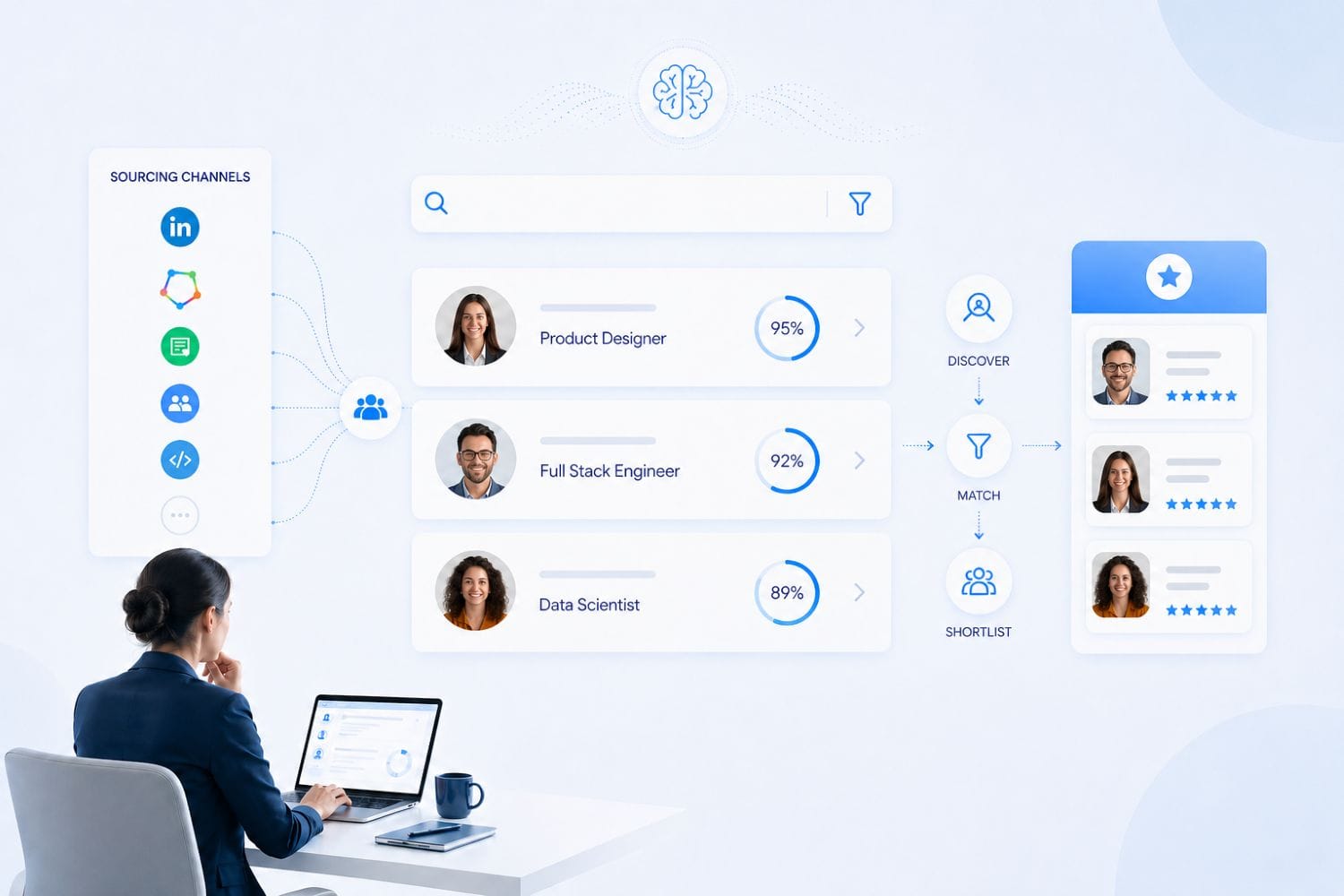
Posting a job and waiting is not a talent sourcing strategy. It’s a queue. And in a market where roughly 70% of the workforce is passive, employed, not browsing job boards, not updating their CV, a queue is a losing position.
A talent sourcing strategy is a deliberate, proactive approach to finding and engaging the right candidates before they apply for anything, and often before you have an open role at all. The organizations that consistently hire well in 2026 aren’t just faster. They’ve built a real system: clear frameworks, channels matched to role types, outreach that gets replies, and metrics that actually inform decisions.
That’s what this guide covers.
What Is Talent Sourcing? And How It Differs from Recruiting
The terms talent sourcing, recruiting, and talent acquisition are used interchangeably, but they aren’t the same thing. Getting this distinction right changes how you structure your function and where you spend your time.
Talent sourcing is the proactive identification and engagement of potential candidates for current or future roles. The sourcer finds people. They don’t wait for people to find them. Talent sourcing is one piece. The recruitment strategies guide covers everything around it: role definition, job descriptions, screening, interviews, and performance metrics.
Recruiting is the more reactive process that follows sourcing, screening candidates who have expressed interest, managing interviews, coordinating evaluations, and making offers. Recruiting begins when sourcing has generated a shortlist. The next step after the shortlist is a structured candidate screening process to evaluate candidates consistently before interviews.
Talent acquisition is the overarching strategic function encompassing workforce planning, employer branding, and long-term pipeline development.
Understanding where sourcing ends and recruiting begins matters because they require different skills, different tools, and different success metrics. The most common structural mistake in TA is asking recruiters to source and recruit simultaneously for the same role, then wondering why neither is done well.
Why Most Candidate Sourcing Strategies Fail
Most sourcing strategies underperform for one of three reasons, and none of them are tool problems.
Starting the search when the role opens. Reactive sourcing, beginning with candidate identification when a position becomes available, puts you immediately behind. Passive candidates typically take weeks to months to convert from first contact to offer acceptance. If you start sourcing on day one of a vacancy, you’re weeks behind an organization that started six months ago.
Using the same channel for every role. LinkedIn for a senior data scientist. LinkedIn for a warehouse logistics manager. LinkedIn for a graduate marketing coordinator. The platform is the same; the talent isn’t there in equal measure for each. Mismatched channels produce thin pipelines and frustrated hiring managers who blame sourcing when the real problem is strategy.
Measuring the wrong things. Sourcing teams report applications submitted, InMails sent, and CVs reviewed. These are activity metrics, not outcome metrics. A sourcer who sends 200 InMails and generates 3 qualified interviews is outperforming one who sends 50 InMails and generates 2 qualified interviews, even though the numbers look worse. Activity measures effort. Outcome measures impact.
The 7-Step Talent Sourcing Strategy Framework
Step 1: Define Your Ideal Candidate Profile Before You Search
Every sourcing search should begin with a written ideal candidate profile, not a job description, which is written for applicants, but a sourcing brief written for the person doing the search.
The sourcing brief answers five questions:
- What does success look like at 90 days? This defines the actual requirements rather than the aspirational ones.
- What are the three non-negotiable skills? Not the eight listed in the JD; the three that genuinely cannot be trained.
- What seniority signals matter? Not just years of experience, but what specific career trajectories indicate readiness for this role.
- What cultural context is critical? Startup experience versus enterprise, autonomous versus collaborative. These affect candidate-to-hire conversion rates more than most sourcers account for.
- Where does this person currently work? Identifying the companies, industries, or communities where your ideal candidate spends their time is the most underused technique in most sourcing briefs.
A sourcing brief built on these five questions cuts the time spent reviewing unsuitable profiles and considerably sharpens the relevance of outreach.
Step 2: Map Your Sourcing Channels by Role Type
The single most impactful change you can make to your candidate sourcing strategy is to match your sourcing channel to your role type, rather than defaulting to the same two or three platforms for every search.
Senior and specialist professional roles (finance, legal, consulting, strategy): LinkedIn Recruiter remains the dominant channel for these fields. Supplement with Talentprise AI candidate sourcing for passive specialists who maintain minimal LinkedIn presence but have registered profiles on dedicated talent platforms.
Worth noting: some of the most qualified candidates in the Talentprise pool have near-empty LinkedIn profiles. If your sourcing starts and ends with LinkedIn, you’re missing them.
Technology and engineering roles: GitHub and Stack Overflow surface real, demonstrated work; a developer’s public repositories and contribution history are more predictive of technical fit than most certifications. Combine with AI sourcing platforms like Talentprise for passive candidates and SeekOut Recruiting for enterprise-scale technical searches. LinkedIn for senior individual contributors and engineering leadership.
Healthcare and clinical roles: LinkedIn, combined with specialty platforms; Doximity for physicians; nursing-specific job boards; and professional association directories for allied health. DHA and DOH portals for UAE-based clinical roles. Referral networks within clinical teams remain the highest-conversion channel for niche specialisms.
Graduates and early-career: Handshake for university-affiliated talent. LinkedIn for international graduate programs. Company career pages for graduate schemes before they’re advertised publicly. Campus events and virtual career fairs for volume.
Operational, logistics, and frontline roles: Indeed for volume reach. Snagajob and Jobcase for hourly and frontline positions. Facebook Jobs for local hiring. Employee referrals for cultural fit and retention.
Leadership and executive roles: Proactive talent mapping (see Step 6) rather than reactive posting. Personal outreach from the hiring manager or CHRO carries significantly more weight than a recruiter’s InMail for C-suite and VP-level candidates. Specialist retained search partners for board-level.
For a full comparison of each platform’s features, free tiers, and AI capabilities in one place, see the guide to the best job posting sites for employers in 2026.
Step 3: Build Your Talent Pipeline Before You Need It
The difference between reactive sourcing and strategic sourcing usually comes down to one thing: whether you have a pipeline before the role opens.
A talent pipeline is an organized, nurtured list of candidates who could fill specific roles within your organization, maintained actively even when no vacancy exists. Gartner’s Market Guide for Talent Acquisition Technologies notes that organizations with pre-built talent pools measurably reduce time-to-hire because they don’t have to start a candidate search from scratch when a position opens.
Building a pipeline in practice:
Identify your three to five most commonly hired-for roles, the positions that open recurrently, or that carry the highest business impact. For each, maintain an active shortlist of candidates you’ve engaged, tracked, or identified as strong potential fits. Tools like Talentprise allow you to save candidate profiles for later review, building a searchable sourcing library rather than a static spreadsheet.
Tag candidates by readiness: warm (actively interested; timing isn’t right), passive (strong fit; no current intent to move), and future (strong profile; too early in career). Treat each tier differently in your nurturing approach.
Step 4: Craft Outreach That Gets Responses
LinkedIn InMail response rates average 10–25%. Cold email sits at approximately 5%. The gap between the best and worst performers within those ranges is almost entirely explained by message quality, not message volume.
These are the outreach mistakes that kill response rates. They’re worth knowing because almost everyone makes them at some point.
The generic opener. “I came across your profile and think you’d be a great fit.” Every passive candidate receives a dozen versions of this per week. It signals zero effort and generates zero interest.
Leading with the role. Opening with the job title and company before establishing any relevance to the individual reads like a cold sales pitch, because it is one. Start with why this specific person caught your attention. Reference their actual work: a project, a published piece, a career trajectory.
The wall of text. Three paragraphs of company description in the first message. Nobody reads this. Keep it short enough to read on a phone without scrolling: why you’re reaching out, what you’re looking for, and one question at the end.
The template that forgot to customize. “[Name], I noticed your work at [Company]…” with [Company] left as a literal placeholder. This happens more than you’d think and ends conversations immediately.
Sourcing outreach that converts is personal and specific. It references something that shows you’ve actually read the profile, not just found it. According to Recruiterflow’s 2026 sourcing data, email sequences with three personalized touchpoints across 20 days see response rates approaching 45%, more than double the industry average. The touchpoints matter more than the volume.
Step 5: Use AI Sourcing to Reach Passive Candidates at Scale
The structural limitation of manual sourcing, LinkedIn boolean search, resume database browsing, and job board scraping is time. A skilled sourcer manually reviewing profiles can realistically assess 50–80 candidates per day. For niche or specialist roles where the qualified pool is 200–500 globally, this is adequate. For roles with a pool of 50,000, it’s inadequate.
AI candidate sourcing changes the economics. Instead of describing a candidate using keyword strings, “software engineer” AND “fintech” AND “5+ years”, semantic AI understands what you mean, not just what you type. It surfaces candidates who match the intent of your search, including passive professionals whose profiles describe their experience differently from the keywords in your brief.
Talentprise’s sourcing engine works on this principle. A recruiter describes the ideal candidate in plain language: the role, the context, the experience level, the industry background, and the platform’s semantic AI searches a verified pool of over one million opted-in candidates, ranking results by contextual fit rather than keyword overlap. Candidates who would be invisible to a Boolean search, because they use different terminology, hold equivalent qualifications under different titles, or simply don’t match the exact phrase, are surfaced. Refer to the How to use AI in Recruitment guide to learn more.
For a full breakdown of how AI changes every stage of the candidate sourcing process, including outreach automation, resume screening, and pipeline analytics, see our guide to using AI in recruitment in 2026.
This approach doesn’t replace human judgment, it focuses it. Instead of reviewing 400 profiles to find 10 viable candidates, you review a ranked shortlist of 20 and spend your time on the 8 who are genuinely worth engaging.
Step 6: Nurture the Candidates You Can’t Hire Today
Every candidate who isn’t quite right for today’s role, wrong timing, slightly different background, not yet senior enough, is a potential future hire if you maintain the relationship. Most sourcing teams lose that value entirely by treating pipeline candidates as either active or irrelevant. There is a third category: nurture.
Set a calendar reminder to follow up with your top pipeline candidates every 90 days. Not to pitch a role, just to stay in contact. Share a relevant article, acknowledge a career milestone, or reference something they’ve published. This takes about three minutes per candidate and keeps you top of mind when they’re ready to move.
The return compounds quietly. A candidate who receives three thoughtful touchpoints over nine months, then decides it’s time to move, thinks of your organization first. Referrals from nurtured pipeline candidates, “you should talk to my recruiter”, are among the highest-quality sourcing leads available.
For large-scale nurture, CRM tools (Beamery, Avature, Greenhouse CRM) automate sequenced outreach. For smaller teams, a structured spreadsheet and calendar reminders accomplish most of the same outcome at zero cost.
Step 7: Measure What Actually Matters
The metrics worth deprioritizing: InMails sent, CVs submitted, and applications generated. They measure activity, not outcomes. Tracking them tells you how busy the team is, not whether it’s working.
Metric 1: Source of hire by quality-of-hire outcome
Not just which channel produced the hire, but also which channel produced the hire who was still performing at 12 months, got promoted within 18 months, or received top manager ratings. Without the quality dimension, source-of-hire data tells you which channel produces the most applications, not the most successful employees. Track this by cohort, by channel, and review it quarterly.
Metric 2: Outreach response rate by message type
Test two outreach variants simultaneously. Measure response rates. After 20 sends of each, eliminate the lower performer and replace it with a new variant. This is the fastest way to systematically improve sourcing conversion without increasing volume.
Metric 3: Pipeline-to-hire ratio by role type
How many sourced candidates does it take to produce one hire, broken down by role category? If your technical roles require 80 sourced candidates per hire and your operational roles require 15, that tells you where to invest more sourcing resources and where the channels are working efficiently. Without this ratio, sourcing resource allocation is guesswork.
The metrics to deprioritize:
- InMails sent: measures effort, not outcome
- CVs submitted: measures volume, not quality
- Applications generated: a lagging indicator of channel performance, not a leading one
To connect sourcing performance with wider hiring outcomes, track these alongside your broader recruiting metrics, including quality of hire, time to fill, cost per hire, and offer acceptance rate.
Candidate Sourcing Strategies by Role Type — Quick Reference
Role Type | Primary Channel | Secondary Channel | AI Sourcing |
|---|---|---|---|
Senior professional | LinkedIn Recruiter | Talentprise | |
Technology and engineering | GitHub, Stack Overflow | Talentprise | |
Healthcare, clinical | Doximity, specialty boards | ||
Graduate, early-career | Handshake | ||
Operational, frontline, hourly | Indeed | Facebook Jobs, Snagajob | |
Leadership, C-suite | Talent mapping + direct outreach | Retained search partner | |
Specific skillsets, specialized roles | Talentprise | LinkedIn Recruiter |
How to Source Candidates Without a Large TA Team
Sourcing at scale with enterprise TA budgets is a solved problem. Sourcing with a team of two, or as a solo recruiter, is where most practical advice breaks down.
The priority order for lean teams:
First: Employee referrals above everything. No channel produces higher-quality hires at a lower cost. Build a formal referral program with a clear incentive structure before investing in any sourcing tool. DigitalOcean generated 40% of all hires through referrals in 2024 by offering a meaningful cash incentive for each successful placement.
Second: One AI sourcing platform, used well. A single AI sourcing platform used consistently, with a well-defined ideal candidate profile and structured follow-up, outperforms three platforms used sporadically. Talentprise’s pay-per-profile model is specifically designed for lean teams: no monthly subscription, unlimited searches, and payment only when you choose to unlock a candidate. This removes the fixed cost risk that makes enterprise sourcing tools prohibitive for smaller organizations.
Third: Nurture as a competitive advantage. Large TA teams are often too busy to nurture. A small team that consistently maintains 50-strong pipeline relationships will outperform a large team that sources reactively for each role. Nurture is the small team’s structural advantage.
The Talent Sourcing Metrics That Separate Strategic Functions from Administrative Ones
According to SHRM’s 2025 Talent Trends research, organizations that track quality of hire by source are 2.4 times more likely to improve their sourcing ROI year over year. Those that track only volume metrics show no statistically significant improvement.
The strategic TA function builds a feedback loop: sourcing data improves channel decisions, channel decisions improve hire quality, and hire quality data improves sourcing criteria. The administrative TA function measures activity and reports on volume.
The difference is not resources. It is a measurement design.
FAQ: Talent Sourcing Strategy
Ready to put this talent sourcing strategy into practice? Start your 7-day free trial on Talentprise. Describe your ideal candidate in plain language and receive a ranked shortlist of verified passive candidates matched to your requirements. No Boolean search, no subscription required to get started. See how to source candidates for a live role.

Editorial Team
Our team is fueled by a passion for crafting valuable content that enriches the experiences of our users, customers, and visitors. We meticulously select meaningful and unbiased topics ranging from tips and guides to challenges and the latest in technology, trends, and job market insights. All curated with care and affection!