
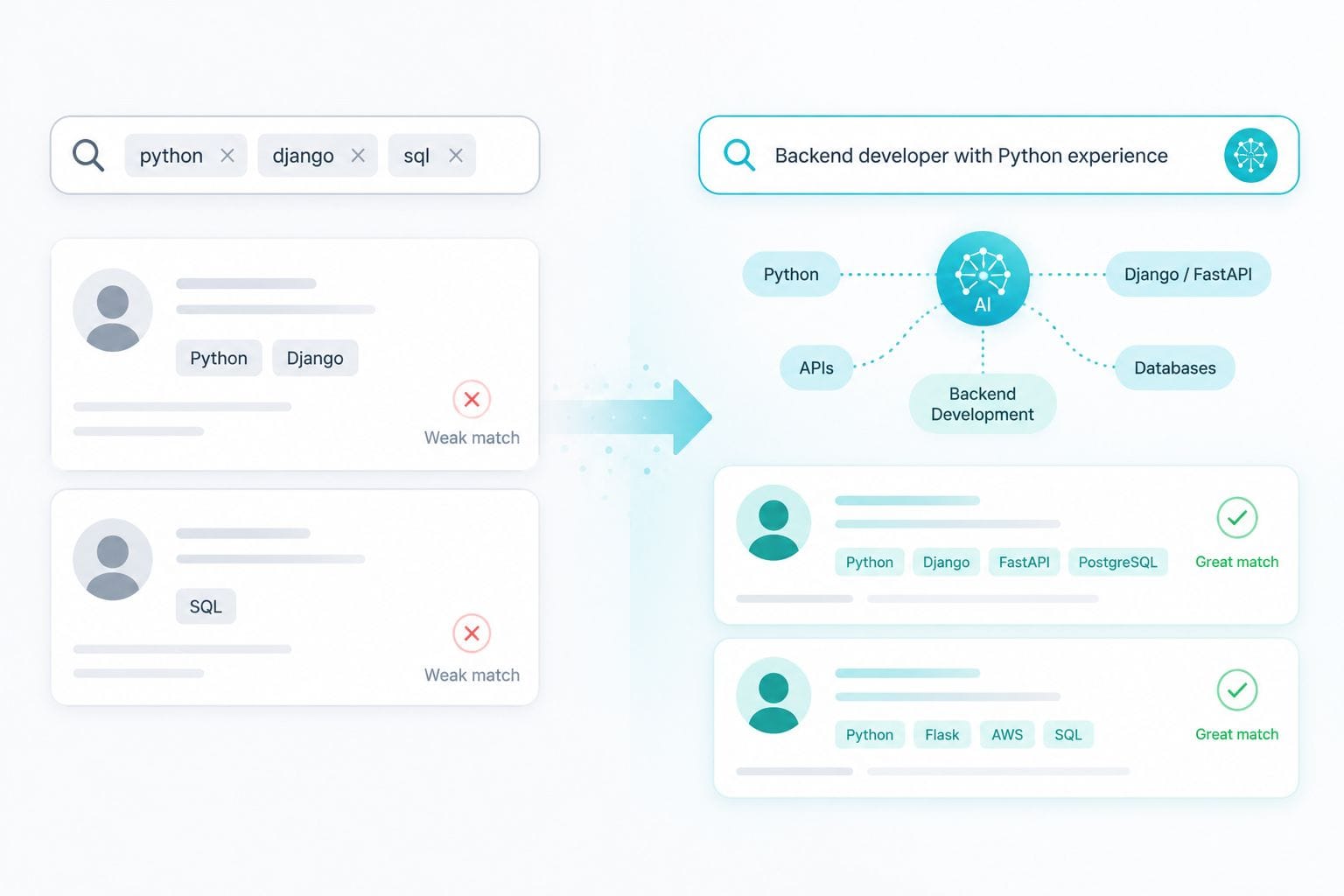
The debate between semantic search vs keyword search in recruitment is not academic; it has a direct cost. A recruiter posts a role for a “Customer Relations Manager.” Two hundred applications come in. The ATS filters by job description terms and surfaces 40 candidates, all of whom used the phrase “customer relations” in their CVs. The remaining one hundred and sixty are dismissed. Somewhere in that group is a highly qualified candidate who described their experience as “client success management.” Same role. Same competency. Wrong words.
This is not an edge case. It is how many traditional ATS filters and keyword-based screening still operate, and it is the structural reason that keyword-dependent hiring consistently produces narrow shortlists from large applicant pools.
Semantic search solves this problem at the root. This guide explains how it differs from keyword matching, what it changes about the screening and sourcing process, where its limits are, and what to look for in platforms that claim to use it. For a broader view of where semantic search fits within an AI recruiting stack, see our complete guide to AI in recruitment.
Keyword Search: How It Works and Where It Fails
Keyword-based search compares specific words or phrases in job descriptions against those in resumes and candidate profiles. The system looks for exact character strings; if the job description says “project management,” it returns profiles that contain those two words in that order or as close variants.
The underlying mechanism is often built around an inverted index: a lookup table that maps words to the profiles that contain them. Depending on the system, results may then be ranked by exact matches, frequency, field weighting, or other keyword relevance signals. It is fast and deterministic, but still limited when meaning matters.
The approach is simple, auditable, and fast. It also creates three problems that compound across every role you fill.
First, candidates who do not use the recruiter’s exact phrasing are excluded regardless of their qualifications. A “Scrum Master” in a technology company, a “Production Coordinator” in a manufacturing plant, and a “Program Administrator” in healthcare may share similar responsibilities in coordination, stakeholder management, and delivery, but keyword filtering treats them as unrelated profiles.
Second, the system cannot detect transferable skills. A candidate who managed a $50M budget at a logistics firm and one who controlled a $50M cost center at a financial services company have equivalent experience; keyword matching has no mechanism to recognize that equivalence unless both use precisely the same vocabulary.
Third, keyword filtering rewards candidates who have learned to game the system, those who mirror job description language in their CVs, over candidates who describe their experience naturally. Over time, this systematically biases shortlists toward a particular type of applicant rather than the most qualified.
That said, keyword search is not always the wrong tool. For roles with non-negotiable binary requirements, a specific professional license, a legal right to work in a jurisdiction, or a security clearance level, keyword filtering is fast, precise, and auditable in a way that semantic matching is not. The problem is not keyword search itself, but its use as the primary mechanism for evaluating candidate fit, where conceptual judgment is required, and vocabulary alignment is not a meaningful proxy for competence.
What Semantic Search Is and How It Works
Semantic search understands meaning rather than matching characters. It uses Natural Language Processing (NLP) and machine learning to interpret the intent and context behind both a job description and a candidate profile, then evaluates the relationship between them conceptually rather than literally.
In practical terms, this works through a process called vectorization. The system converts job requirements and candidate profiles into numerical representations, called vectors, that position related concepts close together in a mathematical space. “Client success management” and “customer relations” sit near each other in that space because the model has learned, from large volumes of text data, that these phrases describe the same competency. A keyword search would treat them as entirely different strings; a semantic search engine recognizes them as equivalent.
The core principles underlying recruitment-grade semantic search are:
Intent recognition: The system interprets what a recruiter is looking for, not just the words used to describe it. A search for “senior commercial leader with B2B experience” returns candidates whose profiles reflect that experience, regardless of whether they used those precise terms.
Contextual understanding: Words mean different things in different contexts. “Python” in a software engineering job description means a programming language. The same word in a biology research role means something entirely different. Semantic search resolves this ambiguity using context, not assumption.
Relationship mapping: The model understands that certain skills cluster together. A candidate with strong SQL experience may have relevant data analysis capabilities, even if “data analysis” does not appear explicitly in his/her profile. Semantic search surfaces these implied competencies.
Continuous improvement: Some semantic systems improve over time when vendors retrain models, incorporate recruiter feedback, or update their matching logic. The improvement is not automatic, so recruiters should ask how the model is maintained.
Semantic Search vs. Keyword Search: Practical Difference with a Concrete Example
Consider two candidates applying for a machine learning engineering role.
Candidate A has “ML engineer” throughout their CV. Candidate B describes themselves as a “machine learning practitioner” and “predictive modeling specialist”, accurate descriptions of the same competency, written in different vocabulary.
A keyword filter built around “ML engineer” returns Candidate A and excludes Candidate B. A semantic matching engine converts both the job description and the candidate profiles into vectors. It determines that “ML engineer,” “machine learning practitioner,” and “predictive modeling specialist” are conceptually proximate, describe similar capability, and so surfaces both candidates ranked by overall fit.
The recruiter using keyword search never sees Candidate B. The recruiter using semantic search can evaluate both and make an informed decision.
Multiply this by a pipeline of 200 applications, and the difference in shortlist quality becomes significant. For a deeper look at how this plays out in the candidate screening stage specifically, our AI candidate screening guide covers the practical mechanics in detail.
This is the essential outcome of semantic search vs keyword search in recruitment: one system finds those who used the right words, the other finds those who have the right skills.
Hybrid Search: What Most Modern Platforms Actually Use
In practice, the choice between semantic search and keyword search is rarely binary. Most enterprise recruitment platforms in 2026 use hybrid search, running keyword and semantic queries simultaneously and merging the results based on a weighted relevance score.
This matters for recruiters evaluating platforms. A hybrid approach captures the strengths of both methods: keyword search handles hard requirements precisely, a specific certification, a security clearance level, and a minimum years threshold, while semantic search handles conceptual fit and surfaces candidates whose experience matches without vocabulary alignment. Neither method alone achieves both.
When a vendor claims their platform uses “AI search” or “intelligent matching,” the relevant follow-up question is not whether they use semantic search; it is how they balance semantic and keyword signals, and whether hard filters are applied before or after the semantic ranking. Hard filters applied after semantic ranking can surface unqualified candidates who score well on fit but fail non-negotiable requirements. Hard filters applied first, with semantic ranking on the qualifying pool, produce more reliable shortlists.
Benefits of Semantic Search in Recruitment
Broader, more accurate candidate pools
Semantic search expands the effective talent pool without expanding search effort. Candidates who describe their experience using industry-specific terminology, regional variations, or non-standard job titles become visible alongside those who happen to mirror the recruiter’s language. For roles in fast-moving sectors, such as technology, healthcare, and financial services, where terminology evolves quickly, this matters considerably.
Better shortlist quality
Because semantic matching evaluates conceptual fit rather than vocabulary overlap, the candidates it surfaces are qualified by actual competency rather than by their ability to mirror job description language. In one randomized AI-assisted recruitment study, involving 37,000 applicants, candidates advanced through the AI-assisted pipeline passed the final human interview at a rate of 54%, compared with 34% in the traditional screening process. While this does not isolate semantic search alone, it supports the broader point that AI-assisted screening can improve shortlist quality when implemented carefully.
Reduction in vocabulary-based bias
Keyword filtering contains a structural bias that is rarely acknowledged: it favors candidates who have learned to write CVs in recruiter-speak over those who describe their experience authentically. This disproportionately affects candidates from non-traditional backgrounds, career changers, and those whose professional development occurred in sectors with different terminology conventions. Semantic search does not eliminate bias; ML models carry their own risks, covered in the next section, but it removes one specific and pervasive source of it.
Time savings in screening
LinkedIn’s 2025 Future of Recruiting report says TA professionals who use or experiment with generative AI report saving about 20% of their workweek. That supports Al-enabled recruiting efficiency, but not semantic search specifically.
Improved use of candidate databases
Existing talent pools, past applicants, previous candidates, and employee referrals often include qualified people who were filtered out due to keyword mismatches during their applications. Semantic search can reprocess these databases and surface candidates who were previously invisible, reducing the cost and time of external sourcing for new roles.
The Bias Risk You Cannot Ignore
Semantic search reduces vocabulary-based bias. It does not eliminate bias from the recruitment process.
Machine learning models are trained on historical data. If that data reflects past hiring decisions that contained patterns of bias, favoring candidates from particular educational institutions, companies, or demographic backgrounds, the model learns those patterns and reproduces them. It does so consistently and at scale, which means bias that was previously irregular becomes systematic.
In regulated markets, this is no longer optional. In New York City, Local Law 144 requires covered employers that use automated employment decision tools to complete an independent bias audit and make audit information publicly available. Under the EU AI Act, many recruitment-related AI systems are classified as high-risk, with major compliance obligations taking effect from August 2026.
Any platform that claims to use semantic AI in screening should be able to answer two questions directly: has the system been independently audited for bias, and are the results published? A vendor that cannot answer these questions clearly represents a compliance liability, not a solution.
Adoption Challenges
Infrastructure requirements
Semantic search is computationally more demanding than keyword matching. Organizations building in-house capabilities need to account for the processing requirements of embedding models and vector databases. In practice, most recruiting teams use semantic search via SaaS platforms rather than building it themselves, shifting the infrastructure burden to the vendor.
Data quality dependency
The accuracy of semantic matching depends on the quality of the underlying data. Vague job descriptions produce vague matches. Candidate profiles that are sparse or outdated limit the model’s ability to accurately assess fit. The technology amplifies data quality; good inputs produce better results, poor inputs produce poor results at a greater speed.
Integration with existing systems
Embedding a standalone search capability outside your existing ATS or HR system creates friction. Recruiters who have to export, re-upload, or manually transfer data between systems will not adopt the tool consistently. Integration depth should be a primary evaluation criterion before any platform decision. Semantic search only creates value when it integrates with the rest of the hiring workflow; therefore, it should be evaluated as part of a broader recruitment technology stack rather than a standalone search feature.
User adoption
Recruiters accustomed to Boolean search and keyword filtering may initially distrust results that surface candidates who do not obviously match the job description text. Training and calibration time are required before the quality improvement becomes visible and trusted.
What to Look for in a Platform Using Semantic Search
Verify the matching mechanism. Ask the vendor to demonstrate, not describe, how their system handles a candidate whose CV uses different vocabulary from the job description. Request a live test on a real role. If the system still relies primarily on keyword matching with semantic labels applied at the surface level, that will be apparent quickly.
Understand the candidate pool. Semantic search quality depends on what it is searching. An opt-in pool where candidates have self-structured their profiles provides a more accurate signal than a scraped database where profile quality is inconsistent, and data currency is unknown.
Ask about bias auditing. Independent third-party audits with published results are the minimum standard for any organization hiring at scale or operating in NYC or with EU-based candidates.
Confirm integration. Semantic matching that lives outside your existing workflow will not be used consistently. Verify integrations before evaluating any other feature.
Evaluate explainability. A good semantic matching system shows you why a candidate was ranked highly, not just that they were ranked highly. Explainable results allow recruiters to validate the reasoning rather than accept the output on trust.
When semantic search is applied inside a talent matching platform, recruiters can move beyond keyword results and receive ranked shortlists based on meaning, context, and candidate fit. If you are comparing platforms, our guide to AI sourcing tools explains how different tools use candidate data, matching logic, and AI workflows to help recruiters build better shortlists.
Talentprise AI Candidate Sourcing applies semantic AI matching to an opt-in candidate pool, where every profile is self-structured by the candidate, giving the matching engine more accurate, up-to-date data than scraped databases provide. View pricing plans or start a search to see how to source candidates for a live role.
Frequently Asked Questions

Editorial Team
Our team is fueled by a passion for crafting valuable content that enriches the experiences of our users, customers, and visitors. We meticulously select meaningful and unbiased topics ranging from tips and guides to challenges and the latest in technology, trends, and job market insights. All curated with care and affection!