
A 2025 analysis of recruiting metrics of over 10 million applications found the applicant-to-interview ratio has dropped to just 3%, down from 8.4% in 2023 and 15.25% in 2016. The average corporate job opening now receives 250 applications. Less than 1 in 33 will reach an interview.
The funnel is narrowing, but not because fewer people are qualified. It’s because the tools most hiring teams rely on to filter that volume are built for vocabulary, not understanding.
AI candidate screening and matching change that equation. This guide explains how it actually works, what it does better than keyword-based systems, what it still gets wrong, and what to look for before you buy.
What Is AI Candidate Screening and How Is It Different From AI Matching?
These terms are frequently used interchangeably. They describe different things.
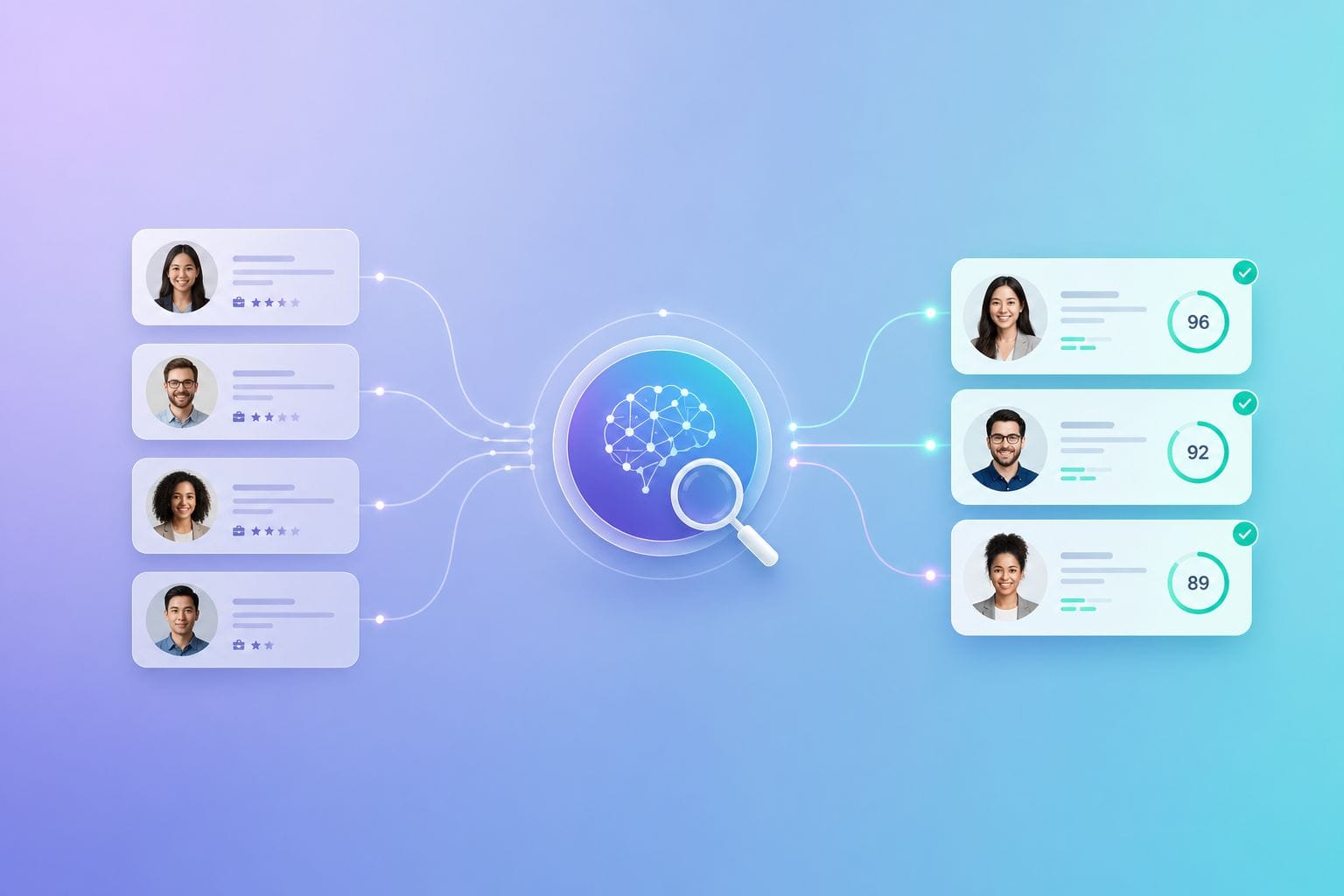
AI candidate screening is the first-pass stage: evaluating applications to determine which candidates meet the threshold to proceed. In an AI-powered system, this involves automated analysis of resumes, profiles, and application data against defined job requirements. The output is typically a shortlist or a ranked queue of candidates.
AI candidate matching goes further. Rather than simply filtering out the unqualified, a matching system assesses the degree of fit, ranking candidates against each other based on how closely their skills, experience, trajectory, and context align with the specific role. The output is a ranked list with confidence scores, not a binary pass/fail.
In practice, most enterprise platforms today do both. The distinction matters because they address different challenges: screening helps recruiters reduce application volume, while a talent matching platform goes further by ranking candidates based on role fit, skills, experience, and context.
Keyword Matching vs. AI Semantic Matching: Why It Matters
Most ATS systems still rely on keyword matching. The recruiter specifies required terms, “Python,” “B2B sales,” “5 years experience”, and the system returns profiles that contain those strings. It is fast and auditable. It is also fundamentally limited.
Consider two candidates applying for a machine learning engineering role. The first has “ML engineer” throughout their CV. The second has “machine learning practitioner” and “predictive modeling specialist.” A keyword filter built around “ML engineer” returns the first and misses the second. Both candidates are equally qualified. One is invisible.
Semantic AI solves this by reading meaning rather than matching characters. Instead of looking for specific words, a semantic matching engine converts job descriptions and candidate profiles into numerical representations, called vectors, that capture conceptual relationships between skills, roles, and experience. The system understands that “ML engineer” and “machine learning practitioner” describe the same competency, because the vectors for those phrases sit close together in the model’s conceptual space.
For a deeper breakdown of how meaning-based matching differs from traditional keyword filters, see our guide to semantic search vs keyword search in recruitment.
The practical result: candidates who describe their experience differently from how the job posting is phrased stop falling out of the funnel. Skills that transfer from adjacent roles become visible. Candidates who would have been filtered out by a keyword mismatch appear in the shortlist where they belong.
This is the foundational difference between legacy ATS screening and AI-powered matching, and it is why simply “adding AI” to an ATS that still runs keyword filtering underneath is not the same as deploying a genuine semantic matching system. For a broader look at where AI screening fits into a complete recruitment approach, see our AI recruitment strategy guide.
How AI Candidate Matching Works, Step by Step
Step 1: Job requirement analysis. The system parses the job description, title, responsibilities, required skills, experience level, and location, and converts it into a structured representation that the model can work with. On modern platforms, this also includes inferences about related skills not explicitly listed, based on what similar roles typically require.
Step 2: Candidate profile vectorization. Each candidate’s profile, resume, work history, skills, and education are converted into the same vector format. This creates a comparable representation for every candidate in the pool, regardless of how they’ve described their experience or what vocabulary they’ve used.
Step 3: Contextual ranking. The model calculates the distance between the job vector and each candidate vector. Candidates with profiles that sit closest to the job requirements, semantically, not just lexically, are ranked highest. The model can also weight specific requirements (e.g., a non-negotiable certification or a minimum number of years) to ensure that hard filters are respected before the ranking is applied.
Step 4: Shortlist delivery. The recruiter receives a ranked shortlist with match scores. On more advanced platforms, the system also surfaces which specific skills or experiences drove each candidate’s match score, making it possible to validate the reasoning rather than just accept the output.
This is what separates automated candidate matching from a simple filter: the system doesn’t just remove the unqualified; it ranks the qualified by degree of fit, with visible reasoning behind each score.
The Benefits, With Data
Time savings that compound across the hiring funnel
The volume problem was established above. What matters here is what happens to recruiter time once AI absorbs the first-pass screening load. LinkedIn’s 2025 Future of Recruiting report, based on a survey of over 1,000 talent professionals and billions of platform data points, found that among recruiting teams actively using or experimenting with generative AI, the average time saved is approximately 20% of the working week, a full day reclaimed per recruiter, per week. That time shifts toward the work that actually requires human judgment: candidate engagement, assessment calibration, and hiring manager advisory.
Better shortlist quality, not just faster shortlists
Speed without quality is a false economy. The more important claim for AI matching is not that it is faster, but that it surfaces candidates that keyword filtering would have excluded. A recruiter who describes a role using one set of vocabulary and receives applications written in a different but equally valid vocabulary will miss qualified candidates at the filtering stage. Semantic AI matching eliminates that gap by evaluating meaning rather than text strings.
A randomized study by researchers at Stanford University and micro1, examining 37,000 applicants for a junior developer role, found that 54% of candidates who passed through an AI-assisted pipeline went on to pass the final human interview, compared with 34% from the traditional pipeline, a 20 percentage point improvement in shortlist accuracy. Notably, both groups faced the same final-stage human interviewers, who were blind to which selection method had been used. The AI-assisted process produced a more qualified shortlist, not just a faster one.
Consistency that manual review cannot maintain
Human screening degrades with volume. A recruiter assessing application 180 applies different standards than they did at application 20, even with the best intentions, cognitive fatigue is well-documented and unavoidable. AI applies the same criteria to every candidate in the pool, regardless of order, time of day, or volume. For roles receiving hundreds of applications, that consistency alone justifies the investment.
What AI screening does not fix
Efficiency gains are real. Shortlist quality improvements are measurable. But neither outcome is guaranteed, and both depend entirely on what the system was trained on and how it is configured. A faster, more consistent screening process that reproduces historical hiring bias is not an improvement; it is the same problem running at greater speed and scale. The next section covers this directly.
The Bias Risk You Cannot Ignore
This section is not optional reading. It belongs in any serious evaluation of AI screening and matching, and the fact that most vendor marketing omits it entirely should be a signal.
Machine learning models learn from data. In AI recruitment, that data is typically historical: past applications, past hiring decisions, past performance records. If your historical hiring contained patterns of bias, favoring candidates from certain universities, certain companies, or certain demographic backgrounds, your model will learn those patterns and reproduce them at scale. It will do so efficiently and invisibly, because the output is a ranked list of names without explicit reasoning.
This is not a theoretical risk. Amazon famously decommissioned an AI recruiting tool in 2018 after discovering it had learned to penalize CVs that included the word “women’s” and downgraded graduates of all-women’s colleges. The model had learned from a decade of predominantly male technical hires.
The regulatory environment has caught up with this risk in two important jurisdictions:
New York City Local Law 144, which took effect in July 2023, requires any employer that uses an automated employment decision tool in hiring to commission an independent annual bias audit, publish the results, and provide candidates with notice at least 10 days before the tool is applied to their applications. Penalties run from $500 per violation, accumulating daily.
The EU AI Act, under Annex III of Regulation (EU) 2024/1689, classifies AI systems used for recruitment screening, filtering job applications, and evaluating candidates as high-risk. Full compliance obligations, mandatory risk assessments, bias testing, human oversight requirements, and transparency disclosures become enforceable from August 2026. The Act applies extraterritorially: if your AI screening tool processes candidates located in the EU, you are in scope regardless of where your company is based.
The practical implication for any recruiter evaluating an AI matching platform: ask the vendor directly whether their system has undergone independent bias testing, whether those results are published, and what their compliance posture is for NYC LL144 and the EU AI Act. A vendor that cannot answer those questions clearly is a liability, not a solution.
How to Evaluate an AI Candidate Matching Platform: 5 Criteria
Choosing the right candidate matching software starts with one question: Does the system match by meaning or by keywords?
1. Semantic matching vs. keyword filtering. Ask the vendor to demonstrate, not describe, how their system handles a candidate who uses different vocabulary from the job description. Request a live demonstration using a real role. If the system relies on keyword matching with AI applied at the surface level, that will be apparent immediately.
2. Candidate pool type: scraped vs. opt-in. Some platforms build their searchable talent pool by scraping LinkedIn and public CV databases. Others, like Talentprise, operate with profiles created by candidates who have opted in and actively maintain their data. Opt-in pools tend to produce better match quality because the underlying profile data is more accurate, structured, and current.
3. Bias audit capability. Does the platform provide any transparency into how match scores are generated? Can you see which factors drove a candidate’s ranking? Does the vendor conduct independent bias testing? These are non-negotiable questions, particularly for organizations operating in NYC or with EU-based candidates.
4. ATS integration. AI matching that sits outside your existing workflow creates friction rather than removing it. Confirm what integrations the platform supports before evaluating any other feature. A matching system that requires manual export and re-upload of candidate data will not be adopted consistently. If you are comparing AI screening tools with your existing applicant tracking system, it is also useful to understand the difference between ATS vs AI recruiting and where each tool fits in the hiring workflow.
5. Pricing model and total cost. Subscription pricing with a fixed credit allocation is easier to budget than per-match or per-shortlist pricing that scales with volume. Understand exactly what counts as a credit usage event before signing anything.
AI candidate screening should not be evaluated in isolation; it should fit into a broader recruitment technology stack that connects sourcing, matching, ATS workflows, and structured evaluation.
Talentprise’s platform combines semantic AI matching with an opt-in candidate pool and a transparent match scoring system. View pricing plans or start sourcing candidates to see how the matching engine works on a live role.
Frequently Asked Questions

Editorial Team
Our team is fueled by a passion for crafting valuable content that enriches the experiences of our users, customers, and visitors. We meticulously select meaningful and unbiased topics ranging from tips and guides to challenges and the latest in technology, trends, and job market insights. All curated with care and affection!