
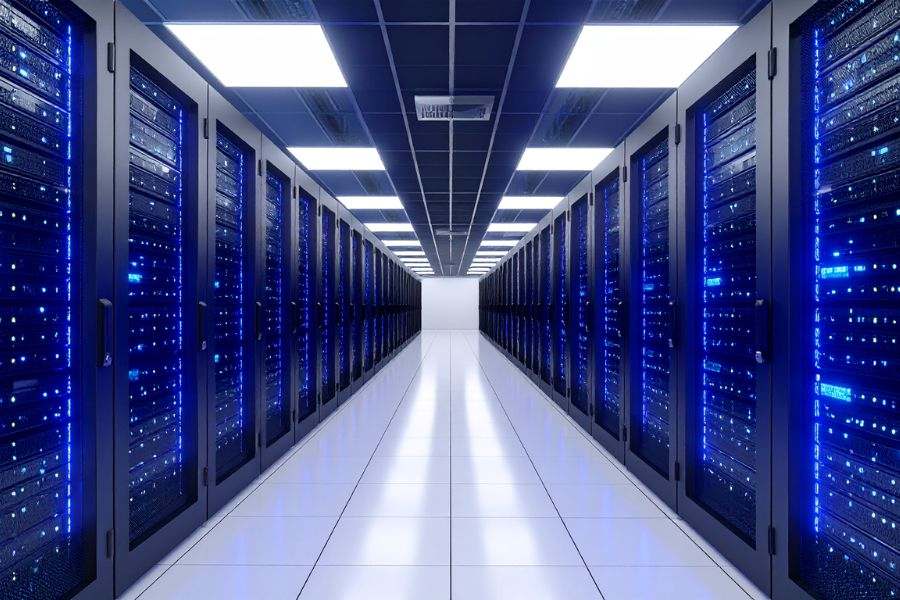
Global Infrastructure, Hyperscalers, Capacity Growth & the Systems That Power the Internet.
The Physical Engine of the Digital Economy
Most people who hear terms like cloud computing, artificial intelligence, streaming services or online banking immediately think of software. But, actually, software is not a tangible entity that we can see, feel or point at. When people “see” a website, an email or a video, what they really see is the outcome of an underlying software system.
But software runs on hardware. And hardware runs inside data centers.
Data centers form the backbone of the modern global digital economy, from the hyperscale AI models that power everything from language translation to self-driving vehicles, to financial trading systems, to cloud-based enterprise applications that power the “digital workplace”. All require highly engineered data centre facilities with the highest levels of reliability and uptime.
The modern data center is not an office server room. Rather than a business facility that also happens to have a few racks of servers, it’s an industrial campus that can be anywhere, as long as there is access to adequate power and land to accommodate IT infrastructure. We’re talking about campus-sized facilities, with infrastructure to support tens to hundreds of megawatts of power. For the hyperscale facilities operated by the largest companies in the tech sector, a single data center can have IT loads of 150 MW or more. And to deliver that capacity to users, the facility can be built in modular phases, over several buildings.
As hyperscalers continue to rollout data centers in numerous locations across the globe and AI workloads on servers are growing while rack density is increasing, the demand for data center personnel is spreading to a global scale.
This article explains:
- The global data center industry landscape
- The difference between hyperscale and colocation facilities
- The engineering systems that define data center operations
- The companies building this infrastructure
- The roles powering the industry
- Why data center careers are expanding long-term
Global Data Center Outlook:
The global data center market is expected to nearly double its infrastructure by 2030 – from around 103 GW today to approximately 200 GW, at a roughly 14% compound annual growth rate (CAGR) – as it responds to the swelling workloads of its applications in AI and the cloud.
What Does a Data Center Consist of?
A data center is a purpose-built facility that allows for computing infrastructure to be accommodated in a highly reliable, secure and controlled environment.
At its core a data center is composed of nine key systems that have been designed to always be up and running.
Dude, you can think of a data center as being like a power plant, cooling plant, telecom hub and security facility all rolled into one highly controlled space.
Let’s break it down.
At its core, a data center consists of nine major systems, all engineered to work together to deliver continuous uptime.
Think of it as a power plant, cooling plant, telecom hub, and security facility — combined into one highly controlled environment.
Let’s break it down.
1. IT Equipment (The Core Compute Layer)
This is the part most people think of first.
It consists of:
- Servers (compute nodes)
- Storage systems (SAN/NAS/SSD arrays)
- Network switches and routers
- GPU clusters (for AI workloads)
- Rack-mounted hardware
- Blade servers
- Edge computing devices (in some facilities)
These are installed inside server racks, typically arranged in rows with hot aisle / cold aisle containment for airflow management.
However, IT equipment is only one part of the data center. It cannot function without the infrastructure that supports it.
2. Electrical Power Infrastructure
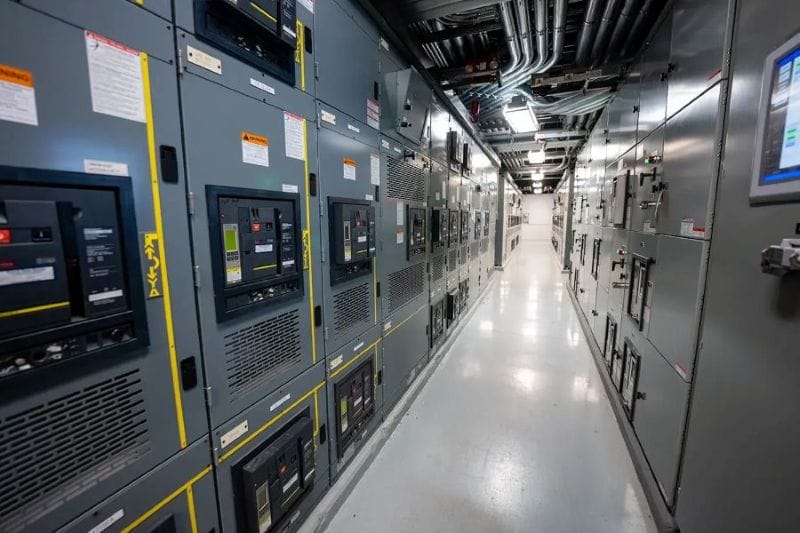
Power is the backbone of a data center.
A typical electrical system consists of:
- Utility grid connection
- Medium Voltage (MV) switchgear
- Transformers
- Low Voltage (LV) switchgear
- Uninterruptible Power Supply (UPS) systems
- Battery banks
- Power Distribution Units (PDUs)
- Busway systems
- Rack-level PDUs
- Backup generators
- Automatic Transfer Switches (ATS)
- Static Transfer Switches (STS)
Redundancy models (N, N+1, 2N) ensure that if one component fails, another can take over without downtime.
In hyperscale facilities, multiple UPS systems and dozens of generators may be installed to support continuous operations.
3. Cooling & Environmental Control Systems
Servers generate significant heat. If not properly cooled, equipment fails.
Cooling systems in a data center consist of:
- Chiller plants
- Cooling towers
- Computer Room Air Handlers (CRAH)
- Computer Room Air Conditioners (CRAC)
- Air containment systems (hot aisle / cold aisle)
- Raised floor or slab cooling
- Liquid cooling systems (for high-density AI workloads)
- Pumps and hydronic loops
- Heat exchangers
- Environmental sensors
Cooling design must maintain temperature and humidity within defined thresholds to protect equipment and ensure efficiency.
AI workloads are pushing cooling systems toward liquid-based technologies due to higher rack densities.
4. Network & Telecommunications Infrastructure
A data center is also a telecom hub.
It includes:
- Fiber entry points
- Meet-me rooms (MMR)
- Main Distribution Areas (MDA)
- Horizontal Distribution Areas (HDA)
- Cross-connect cabinets
- Structured cabling pathways
- Patch panels
- Core routers
- Firewalls
- Network security appliances
These systems allow interconnection between:
- Cloud providers
- Enterprises
- Internet exchange points
- Telecom carriers
High-speed fiber redundancy is critical for availability.
5. Fire Protection Systems
Data centers must protect equipment without causing water damage.
Fire systems consist of:
- Early smoke detection systems
- Aspirating smoke detection (VESDA systems)
- Pre-action sprinkler systems
- Clean agent gas suppression systems
- Fire alarm panels
- Zoning & compartmentalization
Fire protection must balance life safety and equipment protection.
6. Physical Security Infrastructure
Because data centers host critical data, security is strict.
Security systems include:
- Perimeter fencing
- CCTV surveillance
- Access control systems
- Biometric scanners
- Mantrap entry points
- Security command centers
- Visitor management systems
Security operates in layers — perimeter, building, room, rack.
7. Monitoring & Control Systems
Modern data centers rely heavily on monitoring software.
This includes:
- Building Management Systems (BMS)
- Data Center Infrastructure Management (DCIM)
- SCADA systems
- Environmental monitoring systems
- Power monitoring dashboards
- Energy usage tracking (PUE calculations)
- Alarm systems
These systems allow operators to detect anomalies before they cause downtime.
8. Structural & Architectural Components
Beyond equipment, the building itself includes:
- Reinforced concrete floors
- Raised floor systems (in some designs)
- Cable trays & containment
- Seismic bracing
- Blast-resistant walls (in some facilities)
- Loading docks
- Secure equipment staging areas
Hyperscale campuses may include multiple data halls and dedicated utility substations.
9. Sustainability & Energy Optimization Systems
Modern facilities increasingly include:
- Renewable energy integration
- On-site solar arrays (in some regions)
- Energy storage systems
- Water reuse systems
- Advanced economization systems
- Heat recovery systems
Energy efficiency is measured using PUE (Power Usage Effectiveness).
The Global Data Center Market: Hyperscale vs Colocation
The data center industry has evolved into two primary segments.
Hyperscale Owner-Operators
Hyperscale facilities are designed and operated by cloud providers that consume their own capacity. The most dominant global players include:
- Amazon Web Services – AWS Global Infrastructure
- Microsoft – Azure Global Infrastructure
- Google – Google Cloud
- Meta Platforms – META Data Centers
These hyperscale operators build campuses that often include:
- Multiple data halls per building
- Dedicated generator yards
- Redundant substations
- Fiber interconnection hubs
- Advanced cooling plants
Rack densities in hyperscale cloud environments historically averaged 5–15 kW per rack. However, AI workloads now push densities to 30–80+ kW per rack, forcing redesigns in power and cooling strategies.
Colocation & Interconnection Providers
Colocation operators build facilities that lease space, power, and connectivity to enterprises and cloud platforms.
Global leaders include:
- Digital Realty
- NTT
- CyrusOne
- Equinix
Data centers are focused on achieving the highest interconnection density, carrier neutrality, and financial-grade reliability. The hyperscale and colocation data center segments are the largest drivers of Data Center Engineer, Commissioning, and Operations roles globally.
Understanding Data Center Power Infrastructure
Power reliability is the core engineering challenge in every data center.
The standard electrical path includes:
Utility Grid → Medium Voltage Switchgear → Transformers → Low Voltage Switchgear → UPS → Distribution (PDU / Busway) → Rack PDU → IT Equipment
Redundancy configurations (N, N+1, 2N) are often aligned with Tier classifications from the Uptime Institute.
Major equipment vendors include:
- Schneider Electric
- Vertiv
- Eaton
- Siemens
- ABB
A hyperscale building may deploy dozens of modular UPS units in parallel configurations. Generator systems can include multiple megawatt-scale backup generators with fuel redundancy planning.
Careers in Power Infrastructure
Power-focused data center careers include:
- Electrical Design Engineer
- UPS Systems Engineer
- Power Protection & Relay Engineer
- Generator Commissioning Specialist
- Critical Facilities Electrical Technician
- Electrical Reliability Engineer
Electrical engineers in hyperscale environments are responsible for switching procedures, preventive maintenance, and failure simulations under live redundancy conditions.
Cooling & Thermal Engineering in High-Density Environments
Cooling has become one of the most technically complex areas in modern data centers.
Traditional systems include:
- Chilled water plants
- CRAH (Computer Room Air Handler) units
- Cooling towers
- Air containment strategies
However, AI compute density is driving innovation toward:
- Direct-to-chip liquid cooling
- Rear door heat exchangers
- Immersion cooling pilots
Thermal conditions often follow recommendations from ASHRAE.
Careers in Cooling & Mechanical Engineering
- Mechanical Design Engineer
- Thermal Modeling (CFD) Specialist
- Controls & BMS Engineer
- Water Treatment Specialist
- Energy Efficiency Analyst
Cooling professionals are now critical to hyperscale AI deployments.
Network & Interconnection Infrastructure
Modern data centers are global connectivity hubs.
Facilities contain:
- Meet-me rooms
- Carrier-neutral exchange points
- Fiber backbone rooms
- Cross-connect panels
Standards often reference ANSI/TIA-942.
Network-related data center jobs include:
- Data Center Network Architect
- Structured Cabling Engineer
- Fiber Technician
- NOC Engineer
Commissioning & Integrated Systems Testing
Before a data center becomes operational, it undergoes rigorous testing phases:
- Factory Acceptance Testing (FAT)
- Site Acceptance Testing (SAT)
- Integrated Systems Testing (IST)
Commissioning specialists simulate power failures, cooling failures, and redundancy switching.
Commissioning roles include:
- Testing and Commissioning Engineers
- QA/QC Engineer
- Document controller
- Systems Validation Lead
These roles are highly portable globally.
Data Center Operations Careers
After commissioning, long-term operations begin.
Operations teams manage:
- Preventive maintenance
- Incident management
- Vendor coordination
- Capacity planning
- Energy metrics
Typical structure:
Director of Data Center Operations
→ Operations Manager
→ Shift Leads
→ Critical Facilities Technicians (UPS, Switchgear, BMS, ATS, etc.).
Data center operations jobs are known for stability and career progression into management roles.
Why Data Center Careers Will Continue Growing
Three macro forces ensure continued expansion:
- AI compute demand
- Cloud regional expansion
- Digital infrastructure investment by governments
Data center careers encompass electrical engineering, mechanical engineering, network infrastructure, sustainability, and operations management, making them one of the most interdisciplinary fields of infrastructure globally.
Key Data Center Stakeholders
Segment/ Role | Key Players |
|---|---|
Owners / Operators | AWS, |
Colocation / Wholesale operators | Digital Realty, |
Developers / Build-to-suit (BTS) | STACK Infrastructure, |
Program / Project Management | Mace, |
Mission-critical design consultant | |
North America design leaders | |
EPC / General Contractor | DPR Construction, |
Specialist electrical contractor | |
Specialist mechanical / HVAC contractor | |
EU/UK mission-critical contractor / integrator | |
Commissioning and reliability certification | |
Facilities management / Operations outsourcing | Salute, |
Power chain | |
Thermal management | |
Generators and fuel systems | |
IT hardware | Dell, |
Networking |
Talentprise: The Marketplace for Future Talent
Talentprise is an AI-powered talent marketplace built for complex industries like data centers and digital infrastructure. Talentprise uses semantic matching to connect specialized professionals with the right infrastructure projects, accurately and at scale.
If you work in data center engineering, construction, operations, energy, AI infrastructure, or governance, join Talentprise for free. Showcase your expertise, get matched to relevant opportunities, and connect with employers building the next generation of digital infrastructure.
If you are looking to hire highly qualified data center professionals, Talentprise helps you accelerate the engagement with specialized experts and hiring for mission-critical roles through AI-driven matching.
Frequently Asked Questions (FAQ)
What qualifications are needed to work in a data center?
Most technical roles require degrees in electrical, mechanical, or telecom engineering. Certifications such as CDCP, PMP, or vendor-specific UPS and switchgear certifications strengthen employability.
Is data center work only for electrical engineers?
No. Roles exist in cooling design, network architecture, fire protection, sustainability, procurement, and operations management.
Are data center jobs high-paying?
Yes. Due to reliability requirements and technical specialization, many operational and commissioning roles command premium salaries compared to general facilities roles.
What is the difference between Tier III and Tier IV data centers?
Tier III facilities are concurrently maintainable, while Tier IV facilities are fault-tolerant. Tier classifications are defined by the Uptime Institute.
Are data centers growing in the Middle East?
Yes. The UAE and Saudi Arabia are investing heavily in hyperscale cloud infrastructure and sovereign digital capabilities.
Khazna Data Centers to Add Over 1GW Hyperscale Capacity Across Multiple Countries By 2030.

Editorial Team
Our team is fueled by a passion for crafting valuable content that enriches the experiences of our users, customers, and visitors. We meticulously select meaningful and unbiased topics ranging from tips and guides to challenges and the latest in technology, trends, and job market insights. All curated with care and affection!